Bubbel
Make remote work feel less remote.
When remote work became the default in 2020, the structured parts of work transferred fine. Meetings, standups, reviews — all moved to video. But the unstructured social moments disappeared entirely. The coffee machine conversation. Walking past someone's desk and asking how their weekend was. The five minutes before a meeting starts where you actually talk to people.
Those moments weren't on anyone's calendar, so nobody rebuilt them.
Nobody wants to schedule being social.
I interviewed eight people who had been working from home for at least six months. The same pattern kept coming up: they missed social contact but couldn't bring themselves to initiate it. Starting a social call feels weird. Scheduling "casual conversation" is an oxymoron. You don't schedule running into someone in the hallway.
Every tool we have requires you to deliberately decide to be social. That deliberate decision kills the spontaneity.
I also looked at what already existed. Slack huddles, Discord voice channels, Gather.town — all screen-based, all requiring a conscious choice to join. None of them replicate the ambient awareness of having someone nearby. The problem wasn't a missing feature in an app. It was the medium itself.
No screen. No buttons. No interface.
I considered three directions. An app that randomly pairs colleagues for calls (too forced — people hated the randomness). A persistent video feed showing your team's desks (too invasive — nobody wants a camera on them all day). A physical object that communicates presence without demanding attention (this one stuck).
The physical direction won because it solves the medium problem. A notification on your screen is easy to ignore — you're already drowning in notifications. An object on your desk that changes state is different. It's ambient. You notice it the way you notice a colleague walking past your door.
The constraint I set: no screen, no buttons, no interface. If it looks like tech, it feels like work.
A grapefruit-sized desk glow.
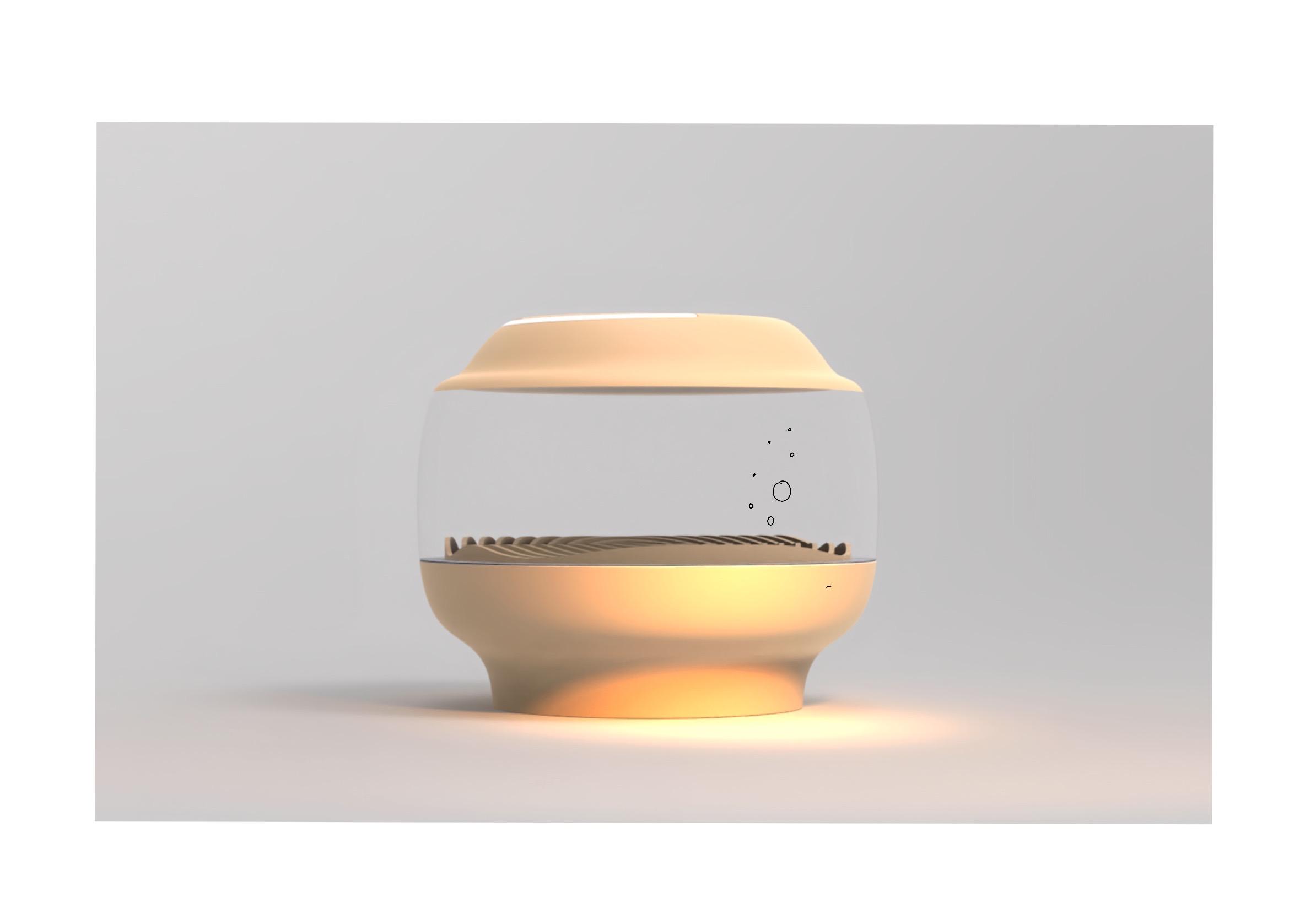
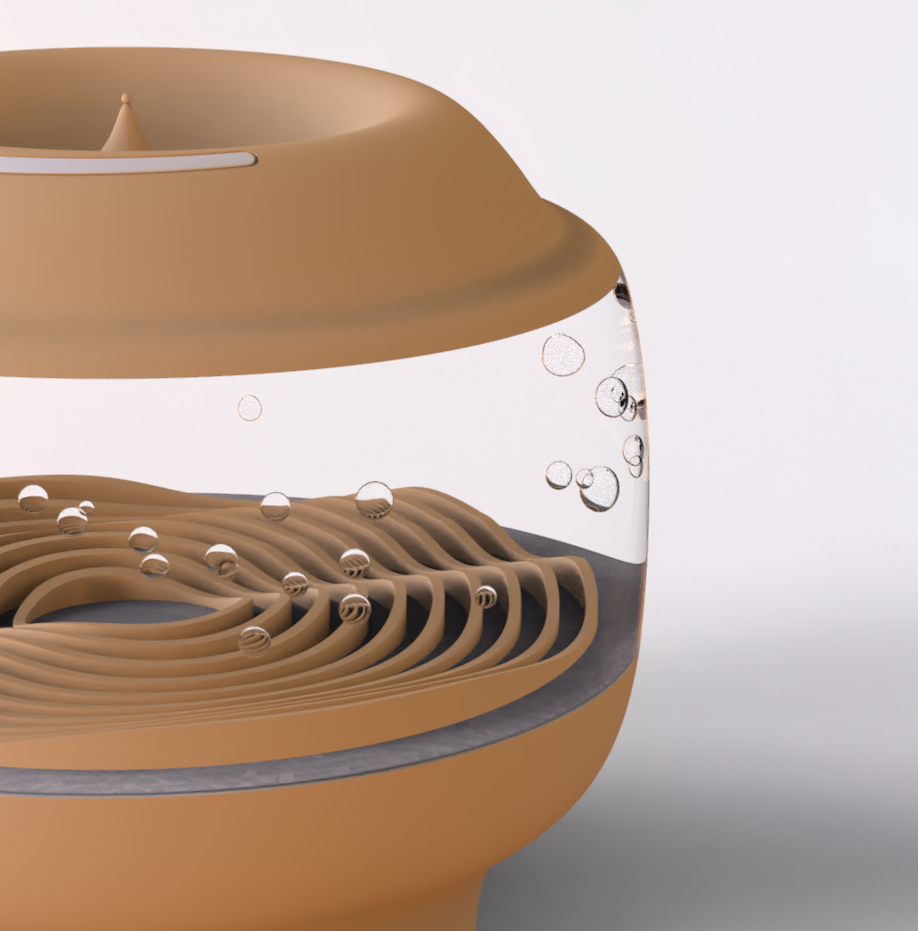
Bubbel is a desk object. A warm, glowing sphere about the size of a grapefruit. A glass band wraps around its equator, showing water inside with slowly rising bubbles and organic, wave-like structures.
When a colleague's Bubbel is active — meaning they're at their desk and open to chatting — yours glows warmer. You tap it, theirs responds, and a call starts. No app to open. No calendar invite. No deciding whether it's worth "bothering" someone. Just a tap.
Ceramic, glass, water.
The form is deliberately not-tech. The materials — ceramic-like shell, glass, water — are meant to feel like something that belongs on a shelf next to books and plants, not next to a monitor and a keyboard. I chose water and bubbles because they create slow, unpredictable movement that you notice without watching. The warm light comes from below, casting soft shadows through the glass.
The internal structure uses concentric wave-like ridges that guide the bubbles as they rise. I modeled these in SolidWorks and 3D printed the prototype shell in two halves. The glass band was the hardest part — I tested acrylic first but it didn't refract light the same way, so I used borosilicate glass for the final version.
Like glancing at an office door.
I gave two working prototypes to colleagues who were both working remotely. They used them for two weeks. The main feedback: the glow actually worked as an ambient signal — one of them said she started glancing at it "the way you'd glance at someone's office door to see if the light is on." The tap-to-call interaction felt natural after the first day.
The criticism was about latency — the glow state update wasn't instant, which sometimes meant tapping when the other person had already stepped away. In a next iteration I'd add a fade-out animation that signals "leaving soon" before the glow disappears entirely.
A screen problem with a physical answer.
This is a concept project — not commissioned, not in production. But the core argument holds: some digital problems have physical solutions. Remote work loneliness is a screen problem, and adding another screen doesn't fix it. An object that sits on your desk and quietly says "someone is around" works because it doesn't demand attention. It just exists, the way a coworker in the next room exists.